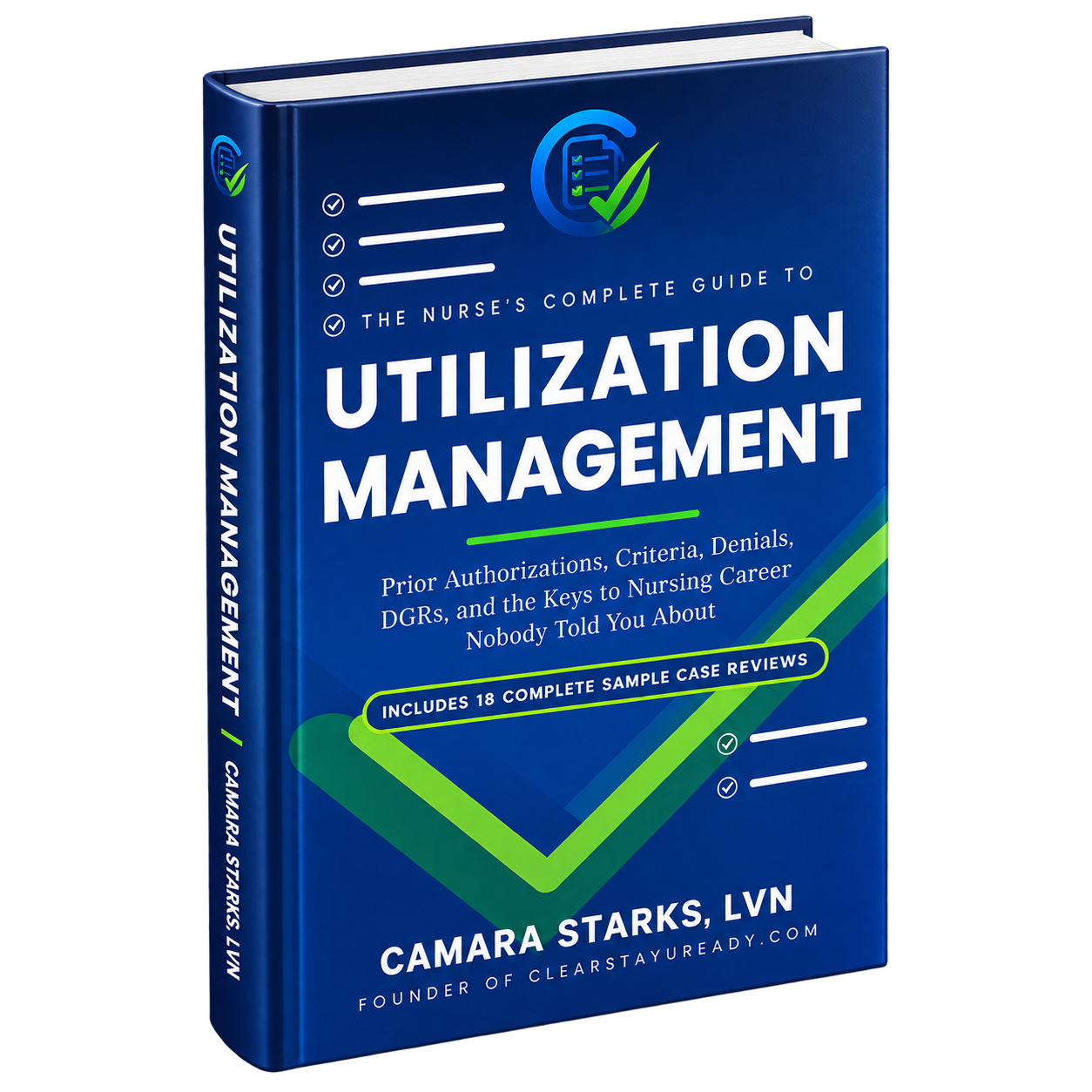
The Nurse's Complete Guide to Utilization Management: Prior Authorizations, Criteria, Denials, DOFRs, and the Remote Nursing Career Nobody Told You About by Mr. Camara Starks, LVN

For RNs and LVNs

The Nurse's Complete Guide to Utilization Management

Leave the bedside. Keep the nursing.

A practical introduction to utilization management for RNs, LVNs, and LPNs. Learn the language of prior authorization, review workflows, and documentation, then explore nursing work beyond the bedside.

The Nurse's Complete Guide to Utilization Management: Prior Authorizations, Criteria, Denials, DOFRs, and the Remote Nursing Career Nobody Told You About by Mr. Camara Starks, LVN

Get the Book on Amazon

Available now in hardcover and paperback.

Listen to the First Chapter of the Book

Get This Book on Amazon

If you've ever cried in your car before a shift, this book was written for you.

Not because you're a bad nurse. Because you're a human one. Twelve-hour shifts on concrete floors were never the only way to use your license, and nobody told you that.

What is utilization management?

Utilization management (UM) is a set of processes used to review the appropriateness of health care services using clinical information, evidence-based criteria, and applicable coverage policies. A review may happen before care, during treatment, or after a service. Nurses can help gather information, document findings, and communicate next steps within their authorized role.

Work from home

UM offers chart-based work. Positions may be remote, hybrid, or on-site, depending on the employer.

Human hours

Schedules vary by employer and role. Review the posting for business hours, weekends, and on-call expectations.

RN or LVN

Explore roles for RNs and LVNs/LPNs. Duties and decision authority depend on licensure, applicable requirements, and employer policy.

Three types of utilization management review

Before care: prospective review

Prior authorization is one form of prospective review. For services that require it, the reviewer examines the request and supporting records before the service is provided. Not every service requires prior authorization.

During care: concurrent review

Concurrent review takes place while care is underway. It can involve reviewing updated records, the current setting, and continued service needs as the care team plans next steps.

After care: retrospective review

Retrospective review examines services already delivered. It uses the available record and applicable policies to evaluate the care under review.

Utilization management vs. utilization review

The terms overlap and organizations may use them differently. Utilization review usually describes reviewing a particular request, service, or stay. Utilization management is often the broader program that organizes those reviews, its policies, and related processes. Learn how your employer defines both terms.

What does a utilization management nurse do?

The work can include reading medical records, locating the applicable policy, identifying missing documentation, recording findings, and communicating with providers and other reviewers. Careful reading, clear writing, and consistent follow-through are useful skills to develop.

Clinical criteria, coverage benefits, and network requirements answer different questions. A complete review must use the rules that apply to the particular request. Reviewers stay within their assigned authority and refer cases that need further clinical review through the appropriate process.

A fictional workflow example

Imagine a request arrives without a referenced visit note. The review begins with organizing what is present and identifying the missing information.

  1. Confirm the requested service and route the request to the appropriate workflow.
  2. Identify the applicable policy and the records needed for review.
  3. Document the missing visit note and request it through the approved channel.
  4. Track the next step and escalate as required by the workflow and review deadline.

This example illustrates documentation and follow-up, not a coverage decision. The book expands on the review process with 16 fictional sample case reviews. You can also practice a mock prior authorization review.

Further reading: StatPearls: Utilization Management, NCQA utilization management, and ANA: the utilization management nurse role.
Inside this utilization management book

The book starts simple and never assumes you already know a term.

Read CPT, HCPCS, and ICD-10 codes the way reviewers do
Process an authorization from fax to decision, and hit every turnaround time
Understand the DOFR, eligibility, benefits, and levels of care
Handle contracted vs. non-contracted providers, including when to redirect members back into network
Find real criteria for free: CMS coverage determinations and public payer policy libraries
Approve what meets criteria, pend what's missing, and refer denials the right way
Navigate tertiary facilities, Centers of Excellence, and transplant cases
Protect yourself with HIPAA-smart remote work habits
Interview with confidence, whether you're an RN or an LVN

16 complete sample case reviews

Each fictional educational case gives you the line of business, codes, sample clinical information, a guideline source, and a completed review note. The excerpt below illustrates the book format; it is not a current coverage determination.

05/27/2026
==================================================
Clinical Review: Pt. is referred for an attended
in-laboratory polysomnography with CPAP titration
due to documented obstructive sleep apnea and signs
and symptoms consistent with sleep apnea.
==================================================
CMS Local Coverage Determination (LCD)
Polysomnography and Other Sleep Studies L36861
==================================================
Recommendations:
MEETS. The treating provider documents obstructive
sleep apnea with clinical signs and symptoms
requiring an attended sleep study...

One of sixteen. Sleep studies, CPAP, spinal injections, power wheelchairs, MRIs, joint replacements, home health, SNF stays, bariatric surgery, cardiac devices, transplants, and more.

ClearlyAuthReady logo

This book started in a hospital bed.

I was sick for a period of time, and suddenly I was the one in the gown, watching the nurses work. They'd see "LVN" in my chart and ask what kind of nursing I do. When I told them, utilization management, from home, still fully a nurse, the room would change. "Wait, from home? Do they hire LVNs? How do I learn it?"

Nurse after nurse, shift after shift, the same hungry questions. I answered as best I could between vitals checks, but those questions deserved more than a hallway answer. They deserved the whole map. So when I recovered, I wrote it.

This book is for all the nurses who want to learn more and leave bedside care.

Mr. Camara Starks, LVN

Ten-plus years in utilization management. Helped build a health plan from the ground up. Founder of ClearlyAuthReady.

ClearlyAuthReady

Read it, then run it.

ClearlyAuthReady lets you select a test and run mock authorization reviews built on the exact skills in this book. Practice before your interview. Sharpen after you're hired.

Try a Mock Review

Pick your format

The Nurse's Complete Guide to Utilization Management: Prior Authorizations, Criteria, Denials, DOFRs, and the Remote Nursing Career Nobody Told You About

Paperback

$24.99

143 pages, 6 x 9

Buy on Amazon
Premium

Hardcover

$34.99

143 pages, 6 x 9, case laminate

Buy on Amazon

Also by the author

The companion guide that started it all.

Utilization Management: A Nurse's Guide to a Fulfilling Career Off the Floor by Mr. Camara Starks, LVN

Utilization Management: A Nurse's Guide to a Fulfilling Career Off the Floor

by Mr. Camara Starks, LVN

The original guide that introduced thousands of nurses to the world of utilization management. If you want the career overview and the mindset shift before diving into the technical deep-end, start here.

Get This Book on Amazon

Available now on Amazon.

Frequently asked questions

Do I need UM experience to get hired?
Requirements vary. Some roles consider nurses new to UM; others require clinical experience or prior review work. Check each job posting. This book introduces the vocabulary and workflow for nurses exploring that transition.
Can LVNs and LPNs really do this work?
Yes. LVNs and LPNs perform prior authorization review at health plans, IPAs, and medical groups nationwide. Scope varies by state and employer, and the book explains those differences.
Do I need a certification first?
Certification requirements vary by position. Review the employer's requirements and the eligibility rules for any credential you are considering. This book is an educational resource, not a certification program.
Is this book just theory?
No. It includes 16 complete worked case reviews, a full mock interview, quick-reference code appendices, and sample job aids.
Isn't utilization management just denying care?
UM includes reviewing relevant records, applying policies consistently, and communicating next steps. Reviewers must work within their authorized role and refer cases that require further review to the appropriate qualified professional.
Is the job really remote?
UM roles may be remote, hybrid, or on-site. Remote positions may have location, licensure, scheduling, and workspace requirements. Check each employer's posting.
Where can I buy it?
On Amazon, in hardcover and paperback: https://a.co/d/09CHajW9

Your license is the key.
This book is the door.

If you're burned out, injured, raising kids, or simply done with twelve-hour shifts, this is your proof that there's another room in the house of nursing.

Get the Book on Amazon